How to Apply When Employers Use ATS or AI
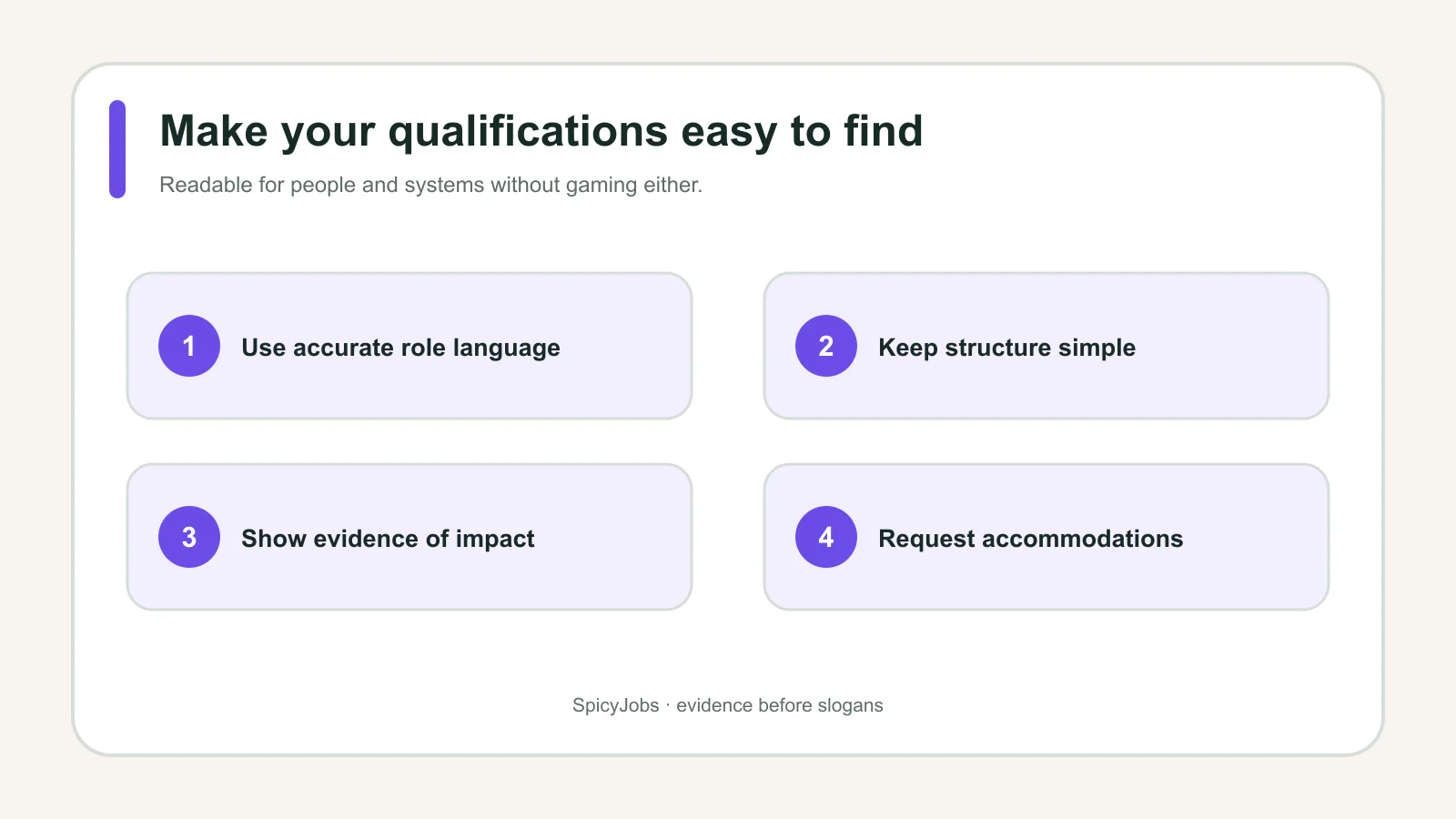
Image: SpicyJobs
Some employers use applicant-tracking software, automated assessments, or algorithmic tools. Others rely on recruiters, hiring managers, referrals, or combinations of these methods.
There is no sound basis for telling every applicant that “AI reads your résumé first” or that one parser decides every outcome. The U.S. Department of Justice describes algorithmic hiring as something employers may use and warns that it can unlawfully screen out a qualified person with a disability.
Start with the actual instructions
Follow the file type, word limit, and fields requested in the application. If the employer asks you to enter work history into a form, do not assume an attached résumé replaces it.
Use:
- conventional section labels;
- readable type and sufficient contrast;
- selectable text rather than a photograph of text;
- dates and titles that agree across documents; and
- a filename that identifies the document without exposing sensitive data.
Complex columns, text boxes, icons, or headers can create parsing or accessibility problems in some systems. That is a reason to test readability, not proof that every designed résumé fails.
Match language truthfully
When a posting uses a precise term for a skill you genuinely have, use that term and show where you applied it.
Weak:
Worked with customers.
More useful:
Resolved billing and access cases through Zendesk and documented escalation patterns for the support lead.
Include a number only when you can substantiate it. “Reduced resolution time by 40%” is not stronger if the baseline, period, or measurement was invented.
Do not paste hidden keywords, claim tools you have not used, or repeat the posting mechanically. A hiring process may include verification, assessments, reference checks, or work samples.
Protect privacy
A résumé generally does not need a Social Security number, bank details, full date of birth, passport copy, or account password. Verify the employer and destination before sending sensitive documents. Hiring scams can imitate real companies and recruiters.
Ask about assessments and accommodations
An online game, video analysis, personality measure, timed test, or résumé score may be part of selection. The EEOC says employment tests and selection procedures must comply with federal anti-discrimination law and, where they have discriminatory effects, may need to be job-related and consistent with business necessity.
The DOJ explains that a person with a disability may need a reasonable accommodation in an algorithmic hiring process. If the process creates an accessibility barrier, use the employer’s accommodation channel when available. Keep a copy of the request and response.
A pre-submit check
- Can you select and copy the text?
- Do the top qualifications appear in the first page or required fields?
- Is every keyword accurate in context?
- Are metrics supported by a record or reasonable explanation?
- Do links open without requiring your private account?
- Did you remove sensitive personal data?
- Did you save the posting and the submitted version?
No résumé format can guarantee that a person or system will advance an application. The goal is accurate evidence that survives both automated and human review.
Source notes
- The U.S. Department of Justice algorithmic-hiring guidance explains disability risks and reasonable accommodations.
- The EEOC guide to employment tests and selection procedures explains job-relatedness, validation, and anti-discrimination obligations.
- The EEOC Strategic Enforcement Plan for fiscal years 2024–2028 identifies technology-related recruitment barriers as an enforcement priority.
Source check: 27 July 2026.
This article provides general career information, not legal advice or a guarantee of selection.
career adviceai hiringatsjob search2026 hiringresume tips