2026 Salary Research Guide: Find the Defensible Range
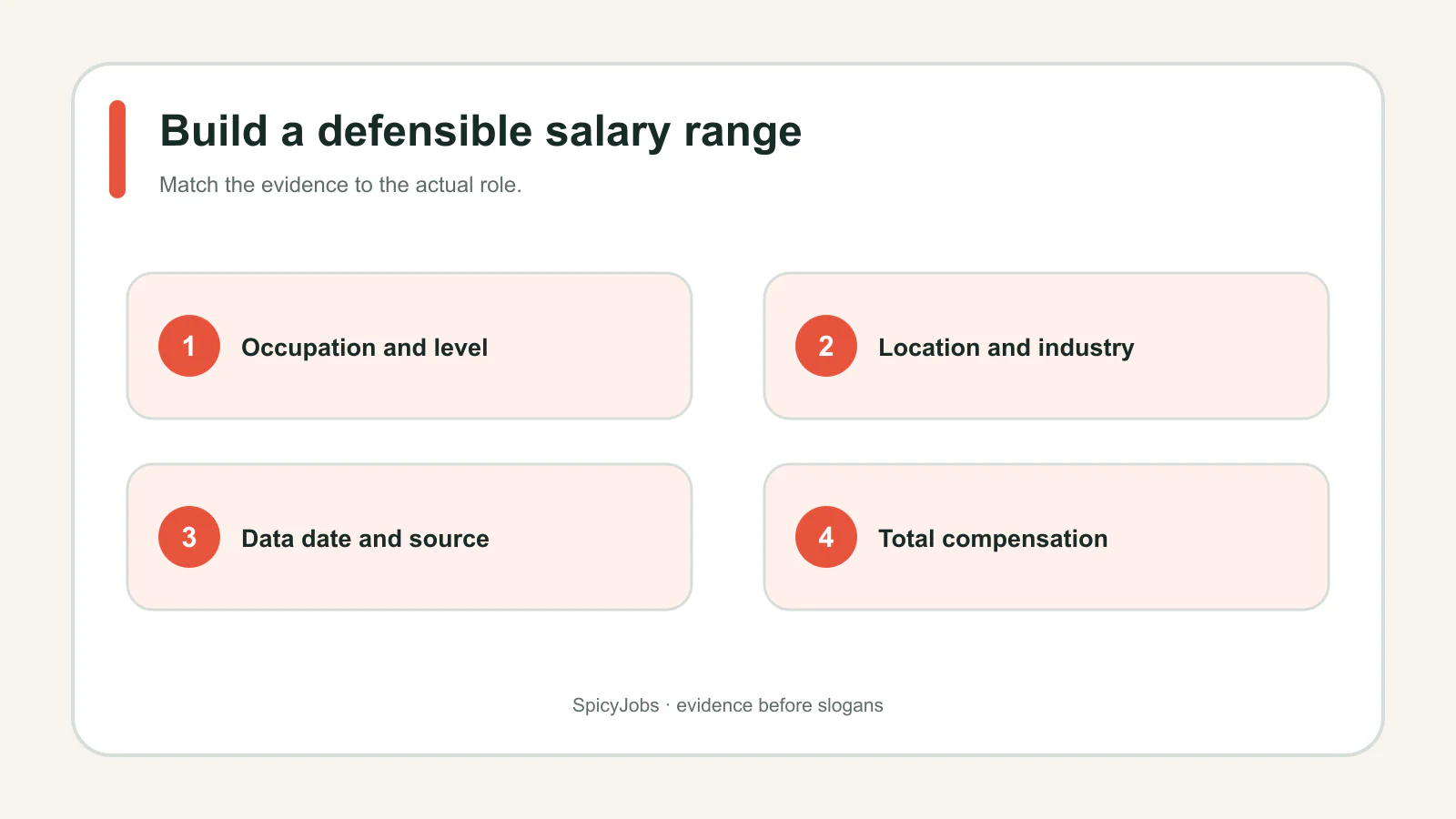
Image: SpicyJobs
A title is not a salary. Two people called “software engineer” may do different work, live in different labor markets, and receive very different bonuses or equity. A useful 2026 salary estimate therefore needs a method, not a recycled table of unexplained numbers.
Start with the data date
The newest U.S. Bureau of Labor Statistics Occupational Employment and Wage Statistics release available as of this review was published on 15 May 2026 and describes May 2025 employment and wages. It covers about 830 occupations.
That is current official evidence, but it is not literally a table of “2026 salaries.” Label the measurement period whenever you quote it.
Long-range employment projections are different again. BLS’s current projections cover 2024–2034. They estimate occupational employment change; they do not measure this month’s vacancies, applicant supply, or an employer’s willingness to pay.
Build a range in five passes
1. Match the work, not only the title
Read the occupation definition and duties. “Data analyst,” “data scientist,” and “business intelligence analyst” can map to different occupational groups. A mismatch can move the benchmark dramatically.
2. Narrow by geography
Use BLS state and metropolitan-area tables where available. Then compare current postings for work that can actually be performed from your location. “Remote” does not always mean work-from-anywhere.
3. Check the industry
The same occupation can pay differently in software publishing, healthcare, government, manufacturing, or consulting. The relevant comparison is the employer’s industry and role scope, not the highest number returned by a search.
4. Separate base pay from total compensation
Record each component:
| Component | Questions to ask |
|---|---|
| Base pay | Annual salary or hourly rate? Guaranteed hours? |
| Bonus or commission | Target or guaranteed? What determines payout? |
| Equity | What instrument, vesting schedule, valuation, and exercise terms? |
| Benefits | Eligibility date, employee cost, exclusions, and leave terms? |
| Location terms | Pay zone, required office days, travel, or relocation? |
A posted salary range may exclude benefits, bonus, equity, overtime, or commissions. Read the jurisdiction’s definition and the posting itself.
5. Account for level and evidence
Compare the stated scope: decision authority, team size, budget, on-call duty, regulatory responsibility, and required expertise. Years of experience alone do not establish equivalent level.
A simple research sheet
Collect at least:
- the occupation and code used;
- the BLS data period;
- the local median and percentile range, if available;
- five to ten comparable current postings;
- base-pay and total-compensation distinctions;
- the role requirements you can document; and
- any assumptions you could not verify.
This produces a range you can explain. It does not determine what you “deserve,” guarantee an offer, or show that every role in a fast-growing occupation will receive large raises.
Pay-transparency data needs context
New York requires covered job advertisements to state a good-faith range for covered opportunities, while California has its own coverage and definition. Other jurisdictions differ and rules change. A posted range is useful evidence of one employer’s budget at the time of posting:not an automatic promise that every candidate should target the top third.
Source notes
- BLS Occupational Employment and Wage Statistics tables, latest release 15 May 2026 for May 2025.
- BLS occupational projections data, currently covering 2024–2034.
- New York Department of Labor pay-transparency guidance explains its covered postings and good-faith ranges.
- California Department of Industrial Relations Equal Pay Act guidance explains California’s posting requirement.
Source check: 27 July 2026.
This article provides general career information, not legal, tax, financial, or compensation advice.
salary guide2026 hiringpay transparencyjob searchcareer growthwage data