Skills-Based Hiring in 2026: What It Does and Does Not Mean
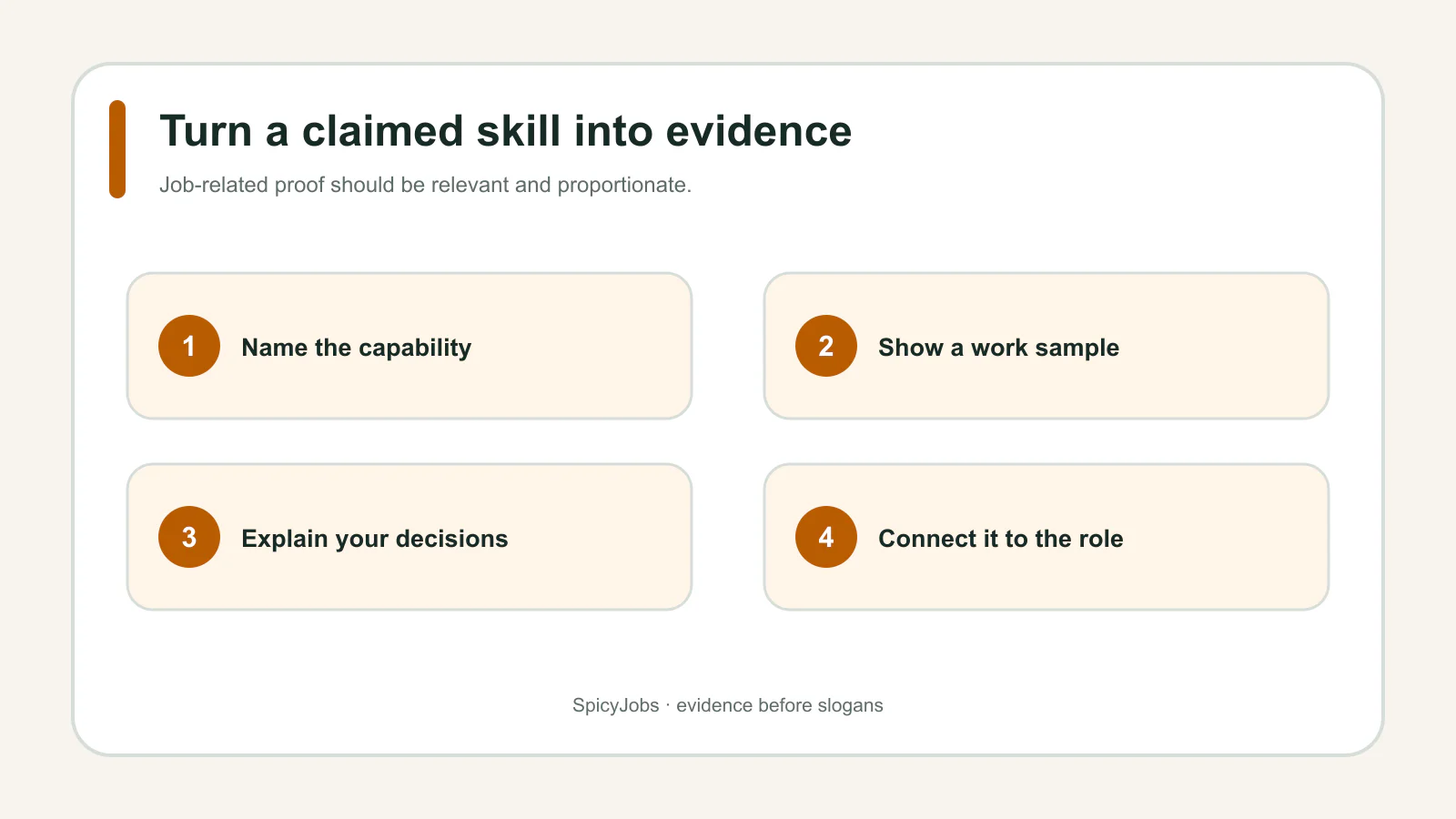
Image: SpicyJobs
Skills-based hiring means evaluating job-related capabilities more directly instead of relying only on titles, degrees, or self-reported experience. It can include structured interviews, technical assessments, portfolios, simulations, or scored work samples.
It does not mean that employers everywhere dropped degree requirements in 2026, that credentials are irrelevant, or that an automated score is inherently fair.
A concrete public-sector example
The U.S. Office of Personnel Management supports competency-based and skills-focused federal hiring. Its materials emphasize job analysis, validated assessments, and measurable competencies. That is evidence of a federal policy direction:not proof of adoption rates across every private employer or industry.
Many roles still require a license, registration, security clearance, statutory qualification, or specific education. Confirm the actual requirement rather than assuming a portfolio can replace it.
What counts as useful evidence
Match the proof to the work:
| Target capability | Possible evidence |
|---|---|
| Data analysis | Reproducible analysis, definitions, validation, and limitations |
| Writing | Published or permission-cleared samples with the brief and edits |
| Software | Working code, tests, documentation, and your contribution |
| Design | Case study showing constraints, iterations, accessibility, and outcome |
| Operations | Process map, baseline, change, and measured result |
| Customer support | De-identified examples, quality measures, and escalation judgment |
A portfolio should explain the problem, your role, constraints, decision, and result. Do not publish employer secrets, customer data, proprietary files, or a teammate’s work as your own.
Certifications need context
A certification can show that someone passed a defined assessment or completed training. It does not automatically establish job performance, and quality varies.
Check:
- who issues it and whether the issuer can verify it;
- what knowledge or performance it assesses;
- whether it expires or requires renewal;
- whether employers in the target role request it; and
- the full cost, including exams and continuing education.
Evaluate hiring tests too
Applicants can ask what a test measures, how long it should take, whether it is paid, how submitted work will be used, and what accommodation process exists.
The EEOC explains that selection procedures can violate federal anti-discrimination law if they disproportionately exclude a protected group and are not justified as job-related and consistent with business necessity. Vendor marketing does not transfer responsibility away from the employer.
Be cautious with extensive unpaid assignments that resemble usable client work. Keep the prompt, your submission, and the stated terms. The legality and ownership of test work depend on jurisdiction and agreement.
Present a skills-focused application
- Identify the essential duties in the posting.
- Map each duty to truthful evidence.
- Put the strongest relevant examples near the top.
- State your individual contribution to team work.
- Quantify outcomes only when the measurement is supportable.
- Disclose licensed assets or AI assistance where relevant.
- Meet mandatory credentials; do not imply they are optional.
Skills-focused hiring can create another path to demonstrate capability. It is not a guaranteed interview or a universal substitute for education.
Source notes
- OPM’s hiring-assessment services describe job analysis, competency models, structured interviews, and work simulations in federal hiring.
- OPM Merit Hiring Plan resources collect current federal skills-based and assessment guidance.
- The EEOC employment-test guide explains job-relatedness, validation, disparate impact, and employer responsibility.
Source check: 27 July 2026.
This article provides general career information, not legal advice or a guarantee of selection.
hiring trendsskills-based hiring2026 recruitingjob searchcareer growthwork samples